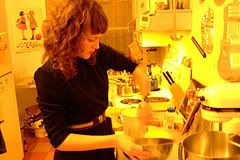
Do orphans love porridge? Doubtless any orphan worth his salt would kill for a bowl of such steaming goodness. As Dickens taught us, orphans are traditionally fed gruel, which is not at all the same thing as porridge, though they may be related. Gruel is essentially a very, very thin porridge. This thinning tends to devalue the dish. If you watered down another of your favorite foods, the result would be equally unpalatable. Imagine soaking a piece of delicious cake in a pot of water, or stirring three cups of water into your poutine. No, it simply wouldn’t do. And yet, I had to be certain. I had to try it for myself.
I found a recipe for gruel on my favorite new website,
Mr. Breakfast.com. When I relayed the recipe to a friend, she told me it is also a good formula for glue or paste. I was obviously taken aback—only second graders eat paste! But her story checked out. The recipe I found for flour paste was almost indentical to that for gruel. Of course, the glue recipe contains no salt, as you’re not expected to attempt to eat it, though one wonders how much a meagre teaspoon of salt can elevate glue to a meal. Somehow, pondering this question rather turned me off the idea of whipping up a steaming vat of gruel, and I procrastinated on the task for as long as I possibly could. The idea actually made me feel a little nauseous. But the time for me to perform finally came—and I botched it.
It’s hard to say what went wrong. I suppose it was foul vanity which led me to believe that a dish perfected by evil orphan-starving nuns or foul-smelling charwomen would be a breeze for yours truly to make. I learned my lesson, though, for I concocted no gruel. I boiled my cup of water. I mixed my two teaspoons of flour with my teaspoon of salt in a little bowl. I dripped water upon it, forming a paste, and I added that back into the pot. But no semi-fluid consistency was reached. Instead, I made the most vile little flour dumplings in a tasteless water-broth saltier than the very sea. So dejected was I that the pot was left carelessly on the stove to fester. I tried with all my might to muster the courage and the thirst for knowledge to make another bold attempt, to make gruel and make it right so that I might truly know the orphans plight. But I simply could not find it within myself. After all, I had much juicier topics than gruel to pursue on the subject of porridge.
I was sitting at the local coffeeshop discussing the merits of porridge and also of some South African malt cereal, when a friend happened upon the scene claiming some pretty scandalous porridge facts. “Truly,” he began, “porridge was nearly banned by the clergy on account of the belief that hot food in the morning was too stimulating and caused morning erections. Thus, cold cereal was born.” Well, you can imagine I did all I could to try and substantiate this story with thorough internet research. As badly as I wanted to believe this amazing tale, its teller was also the man who told me about the woman in India with the x-ray vision and the Russian toddler who could lift a car with one hand.
As it turns out, his story wasn’t quite true, but it did contain some verifiable elements. After all, people’s diets are often influenced more by fad, religion, suspicion and prejedice than actual nutritional value or savor. This is no less true for porridge. In the Middle Ages, some foods—oats among them—were classified as coarse, the eating of which was thereby believed to coarsen the character. Similarly, that horses enjoy oats has long prejudiced people against their consumption by humans. Pliny, for instance, much maligned the Germans for their devotion to oaten delights, which he considered only fit for the animal population. In fact, oats were at one time considered a weed not even fit for beasts, simply because they are heartier than most grains. At one time farmers would pull them up from their wheat fields and burn them in great piles. All this considered, it isn’t implausible that some religious sorts might invent a disinclination towards hot breakfast foods.
The health food faddist movement of nineteenth century America that spawned cold breakfast cereal didn’t have a particular vendetta against porridge, but they certainly did believe that certain foods led not only to bad health but also bad conscience. Sylvester Graham (of the eponymous crackers), was a revivalist clergyman bent on eliminating immorality through wholesome diet. He explained, "All kinds of stimulating and heating substances; high-seasoned food; rich dishes; the free use of flesh; and even the excess of aliment; all, more or less—and some to a very great degree—increase the concupiscent excitability and sensibility of the genital organs…” Graham’s contemporary, John Kellogg, was possessed of similar beliefs, and prescribed a bland, abstemious diet to men in order to cure terrible and debilitating ailments like wet dreams and morning erections.
Kellogg was the author of
Plain facts for old and young : embracing the natural history and hygiene of organic life, which he evidently wrote on the night of his honeymoon for a marriage that, though lifelong, apparently remained unconsummated. While his text primarily addresses the perils of masturbation, he also dispenses a good deal of what he called “general health advice.” It seems he felt that his fellow Americans were in dire need of direction: “We have met people whose tastes had become so utterly perverted that they had acquired a decided fondness for cheese alive with ‘skippers.’” He clearly agreed with me on the point that people’s diets are far too often designed according to fashion, but he advocated an extreme alternative. At his sanitarium, the diet was light, vegetarian, coffee- and alcohol-free, and very rich in enemas of both the water and yogurt variety. For his constipated patients he invented a cold breakfast cereal which he christened Granula—odd, because James Caleb Jackson, another staunch vegetarian and the operator of the Jackson Sanitorium in Dansville, NY, had already invented the first cold breakfast cereal, which he had dubbed…. Granula. Kellogg changed the name to Granola after being sued.
All that said, and as much as I consider him a truly unsavory character, I like to think Kellogg would have approved of porridge, at least perhaps if it was served cold and congealed. After all, everyone has a different way of enjoying the dish. The Scots, possibly the greatest porridge-lovers in the world, eat theirs plain and unadorned, with only a bowl of cold cream or milk served alongside in which to dunk each spoonful. They consider their English neighbours rather effeminate for sweetening their porridge—something they only tolerate in children. The Scottish even have a utensil designated solely for the purpose of stirring porridge. It is called a “spurtle” and looks rather like a magic wand carved out of wood. In fact, they go so far as to hold an annual porridge-making competition called
The Golden Spurtle. Which isn’t to say that Americans don’t like porridge almost as much, even though they are responsible for the creation of cold breakfast cereal. After all, there is an Oatmeal, Texas. And January is nothing if not National Oatmeal Month (so proclaimed by the Quaker Oat Company). Oh, many an American nightly dreams of porridge!
According to Mr. Breakfast (whom I persist in trusting despite the faulty gruel recipe), dreaming that you are eating porridge means that you are well-grounded, whereas dreaming that you are cooking or serving it means that you have control over the fate of someone close to you. Both positive things by me. So keep some oats in your cupboard, even if you don’t indulge that often—scientists have shown that 75% of people consider rolled oats that have been stored 28 years in sealed containers "acceptable in an emergency,” taste- and quality-wise. But please, don’t buy that instant oatmeal. You may consider me a snob, but it is truly foul, most especially in its peaches-and-cream incarnation, and simply not fit to be called porridge, though I suppose it’s really up to each man to decide for himself. My Welsh ancestors would have been enjoying their brewis, an unappetizing-sounding oatmeal broth, while my Scottish relations ate their salty, spurtle-stirred oatmeal. I admit I am thankful that times have changed and the following is the porridge that I learned to make from my dear old dad and that I intend to teach to any children I may chance to meet.
Porridge for Two: My Best RecipeIn a medium saucepan, combine 3/4 c. of water and 3/4 c. of homogenized milk (or use all milk if you’ve only got the weak stuff). Add about a tablespoon of maple syrup and a dash of pumpkin pie spice, along with a modest handful of dried fruit (golden raisins or dried cranberries are my favorite), and heat on high, stirring once or twice to prevent the milk solids from burning, until you begin to see steam rising off the liquid. Add 3/4 c. old-fashioned rolled oats, stir, reduce the heat to medium-low, and put a lid on it. Continue to stir and reduce the heat as the oatmeal thickens. It should take about ten minutes in all. In the meantime, heat a knob of butter in a small frying pan over medium heat. Fry a scant handful of nuts (I recommend pecan pieces or sliced almonds) until toasty. Throw them into the pot, being vigilant to get any traces of butter in there, as well. It will also improve your oatmeal to add some fruit. Apples, cut into smallish chunks, are good, as are rhubarb and cranberries (though they might require some additional maple syrup)—either of these should be added with the oats. Softer fruits like blueberries are better added near to the end of the cooking time, unless, of course, they are frozen. Finally, when the oatmeal has reached a nice, thick consistency, remove from the heat and let it sit, covered, for a minute of two to consider itself. Serve in deep bowls with maple syrup and pouring cream on the table, along with cups of strong, hot coffee.
(Originally published in
$2 Comes with Mixtape #10, revised January 2008.)